



Imagine walking into a room filled with representatives from a cross-section of industries, from manufacturing to labor, banking and retail. Some were nominated by peers to have a seat at the table; others were invited to apply. Everyone is in full professional dress; every man may even be wearing a tie.
It’s not an uncommon sight when serving in the Federal Reserve System – an experience currently shared by at least five Indiana-based IBA-member employees.
“I was surprised as to how engaged the St. Louis Fed was in the meeting,” said Sydney Whitlock, president of NWSB, Charlestown. He serves on the Community Depository Institutions Advisory Council for the St. Louis Fed. Not only does [St. Louis Fed] President Musalem attend the meetings, but multiple staff attend to learn and hear the council members’ thoughts and viewpoints.”
It’s easy to think of a government body and imagine a congressional hearing orchestrated more for sound bites than productivity. Shane Pilarski, president/CEO of Alliance Bank, Francesville, and member of the Chicago Fed’s CDIAC, says the meetings she has attended have been entirely different.
“I was pleasantly surprised by how much emphasis is placed on listening,” she said. “My experience has been that the Fed spends a tremendous amount of time gathering information from local contacts and regional stakeholders. The conversations are thoughtful and interactive.”
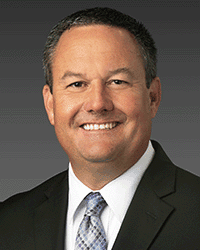
Sydney Whitlock
Title: President, NWSB, Charlestown
Joined bank: 2016
Banking career: 28 years
First job: cleaning or a couple of businesses while in high school
What you’ve been reading: Enjoy leadership books, especially from a specific person’s point of view like John Wooden
Favorite comfort food: chicken wings or a good cheeseburger
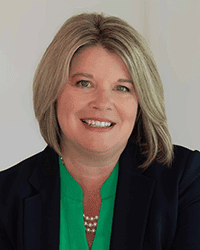
Shane R. Pilarski
Title: President and CEO, Alliance Bank, Francesville
Joined bank: 2002
Banking career: 24 years
First job: math teacher
What you’ve been listening to: Craig Groeschel Leadership Podcast
Favorite comfort food: Totino’s Pepperoni Party Pizza (don’t judge)
D. Neil Dauby, chairman and CEO of German American Bank, Jasper, and its holding company, was elected to the Federal Reserve Board of St. Louis earlier this year. He agreed with Pilarski, saying, “You truly have a voice in the boardroom. The local economic data and challenges that you bring to the table are truly valued and considered.”
Those extra stories – not just the data, but the local stories showing how economic policy impacts everyday Americans – are something all the bankers agreed was paramount to their work with the Fed. Kristin Pruitt, president of Lake City Bank, Warsaw, serves on the Federal Reserve Bank of Chicago’s Board of Directors. As she put it, “Economic data tells a story, but it is not the complete story.”
“The economic data are thorough and informative, of course, but they are backward-looking and often tell yesterday’s story better than today’s,” she said. Effects of economic shocks like tariffs and oil prices “can take time to appear in the data, but business owners and consumers feel them much more quickly.”
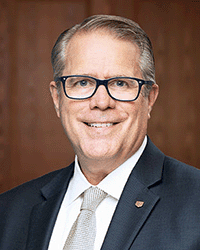
D. Neil Dauby
Title: Chairman and CEO, German American Bank, Jasper
Joined bank: 2001
Banking career: 25 years
First job: IBA stockboy
What you’ve been reading: “Never Lead Alone” by Keith Ferrazzi
Favorite comfort food: Brisket
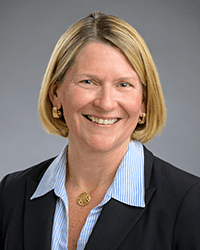
Kristin Pruitt
Title: President, Lake City Bank, Warsaw
Joined bank: 2008
Banking career: 22 years
First job: attorney
What you’ve been listening to: Smatless podcast
Favorite comfort food: Sourdough bread
Community banks are uniquely positioned to provide such insight, living and working directly in their communities. Bankers sit across the table from small business owners, support families, empower local governments and walk the fields of family farms, seeing firsthand every day the realities of how Hoosiers live and how economic policy can best set them up for success.
Pilarski says she sees it as being a translator of sorts.
“Economic reports can show commodity prices, farm income projections or debt levels, but they don’t always capture the human side of the story,” Pilarski said. “Through CDIAC, I’ve had the opportunity to provide perspective on what those numbers mean for real people and real communities.”
It’s not a general task, either. Indiana bankers are providing direct feedback on important policies from stablecoin and AI to Section 1071 and Part 363. Section 1071’s data collection requirements were reshaped through a proposed rule in November 2025, followed by a final rule published May 1, 2026, in part because of feedback from within the Federal Reserve System.
Capitol Hill advocacy and grassroots efforts from outside the System have also impacted the evolution of Section 1071. The Independent Community Bankers of America and American Bankers Association lobbied for changes as part of the November 2025 rulemaking and continue to push for further changes. The new rule exempts any institution that originates fewer than 1,000 small business loans and right-sizes the definition of “small business” to mean businesses with gross annual revenue of $1 million, but ICBA is calling for an exemption for all community banks under $10 billion in assets, an end to the categorical exemption for Farm Credit System lenders and a number of other changes ICBA argues will empower community banks to tailor loans to meet the unique needs of local businesses.
“We’ve spent a lot of time and had vendor selection influenced by how the regulation has evolved – and by concerns about where it may shift back to,” said Kevin Wright, president of STAR Bank, Fort Wayne, and a member of the Chicago Fed’s CDIAC. “I believe the intent of the regulation is good, but I also believe it creates a greater burden, especially in its previous form, on the community banking sector of the industry.”
CDIAC has connected me with a group of thought leaders who share the same passion for community banking that I do.
– Kevin Wright, STAR Bank

Kevin Wright
Title: President, STAR Bank, Fort Wayne
Joined bank: 2008
Banking career: 18 years
First job: mowing grass and painting fences
What you’ve been reading: “Antifragile: Things That Gain from Disorder” by Nassim Taleb
Favorite comfort food: cheeseburger & fries
Both Dauby with the Federal Reserve Board of St. Louis and Wright with the CDIAC in Chicago identified stablecoin as a topic dominating conversation when they go in for meetings (and within the industry overall). Stablecoin regulation has been of particular interest, from how interest and rewards may be governed to an overall lack of clarity in the regulatory environment.
“If stablecoins are permitted to offer deposit-like returns through reward or affiliated platforms, they become something fundamentally different from a ‘payment’ instrument. Instead, they become a direct economic substitute for a bank deposit,” Dauby argued. “If operating balances migrate at scale, then funding capacity migrates, and lending capacity migrates, significantly impacting our ability to serve our communities.”
The Treasury Department released proposed rulemaking on August 17 to require digital asset providers to obtain a federal or state license before issuing payment stablecoins, as required by the GENIUS Act. Officials are asking for public feedback within 60 days of its publication in the Federal Register.
Stablecoin providers represent only one element of an increasingly diverse set of potential competitors to the traditional banking sector – something Whitlock says banks need to continue preparing themselves for over the next 12-18 months.
“I think the most pressing issue is the deposit makeup and competition that our industry faces and will continue to face. The number and type of competition have grown and, in my opinion, will continue to grow. This was a very unifying topic from all the council members at our last meeting,” he said.
Pruitt echoed much the same, saying, “The pace of change in the banking industry is accelerating, driven by technology innovation, new market entrants and changing customer expectations across generations. Much of that change is exciting and beneficial, but it also creates noise that can be distracting. It’s critical for us to stay focused on meeting customers’ needs as we evolve our business in smart ways that make sense for us.”
If we’re not in the room sharing what we’re seeing, then part of the story is missing.
– Shane Pilarski, Alliance Bank
It’s a political adage that if you don’t have a seat at the table, then you’re likely on the menu. Advocating for your customers and the industry doesn’t require a seat at the Fed’s table in particular – the IBA prides itself on empowering its member-banks and their employees to advocate for a favorable climate from wherever you are. But having Indiana bankers at as many tables as possible helps tell the story of banking in as many rooms as possible to enable Indiana’s banking community the freedom to focus on what matters most – serving your customers.
Being a voice among those from other industries has been informative and a growth opportunity for all five of these Indiana bankers, and a reminder, as Kevin Wright put it, that “while the different institution types may have different rules and regulations, each person is representing their perspective and bringing valuable information to the representatives of the Federal Reserve Bank of Chicago.”
That was a polite reference to the fact that the chorus of voices in the room includes credit union representatives – who, Pilarski said, get occasional reminders from bankers in the room “that the playing field is not always the same.”
Still, Wright said, “This is a great opportunity for communities – large and small – to be represented at a broader level.”
“I’m always a little sorry when the meetings end,” Pruitt agreed. “I can’t say that about very many meetings!”